
Batteries are a fundamental pillar of the energy and digital transition we are experiencing. From mobile phones and laptops to electric vehicles and renewable energy storage systems, their presence is increasingly central to daily life and the sustainability strategy of the European Union.
However, the rise of this sector is accompanied by major challenges: scarcity of raw materials, environmental impacts in extraction and manufacturing, difficulties in recycling, risks of hazardous waste, and lack of transparency in supply chain traceability.
In this context, the European Union has approved new regulations on batteries that establish stricter requirements for sustainability, circularity, and transparency. One of the key instruments for compliance will be the Digital Product Passport (DPP) which will be applied as a priority to the battery sector.
In this article, we will analyze how these regulations work, what challenges they pose for manufacturers and operators, and how the iPASS solution can become the definitive tool to ensure compliance and generate added value.
The new european battery regulations: before and after
In June 2023, the European Parliament approved the Battery Regulation, a pioneering law that regulates the entire life cycle of batteries marketed in the European market. Unlike previous directives, this standard is of direct and mandatory application in all Member States.
Some of the most relevant points are:
- Mandatory Digital Passport:
- All industrial and electric vehicle batteries, as well as rechargeable batteries larger than 2 kWh, must have a Digital Passport accessible via QR code.
- This passport will contain information on the composition, origin of raw materials, carbon footprint, life cycle, and instructions for recycling.
- Traceability of raw materials:
- Manufacturers must accredit the responsible origin of lithium, cobalt, nickel, and other critical minerals.
- It will be necessary to demonstrate sustainable and safe extraction practices.
- Recycling and recycled content goals:
- Minimum percentages of recycled material are established in new batteries (e.g., cobalt, lithium, and nickel).
- In addition, targets for the collection and recycling of used batteries must be met.
- Durability and performance:
- Batteries must meet minimum standards for service life and charging capacity, reducing premature obsolescence.
- Consumer information:
- The end user must be able to easily access data such as capacity, efficiency, estimated duration, and repair or replacement possibilities.
The challenge for the sector
The regulations are a major step towards sustainability, but also pose a challenge:
- Complexity in the supply chain: often, materials pass through several countries and processes before becoming a final battery.
- Adaptation costs: implementing traceability and digital certification systems requires investment.
- Regulatory compliance: the risk of penalties is high for companies that cannot verifiably demonstrate their compliance with the law.
Therefore, the sector needs solutions that integrate technology, transparency, and ease of use.
iPASS: a practical solution to comply with regulations
iPASS is a Digital Product Passport system developed by iCommunity that combines blockchain, verifiable credentials, and decentralized identity (DID) systems.
Its differential value lies in the fact that it allows companies and regulators to create, sign, and consult verifiable evidence at each stage of the battery life cycle, ensuring that the information cannot be manipulated.
How does iPASS work in the battery sector?
- Registration of Verifiable Evidence:
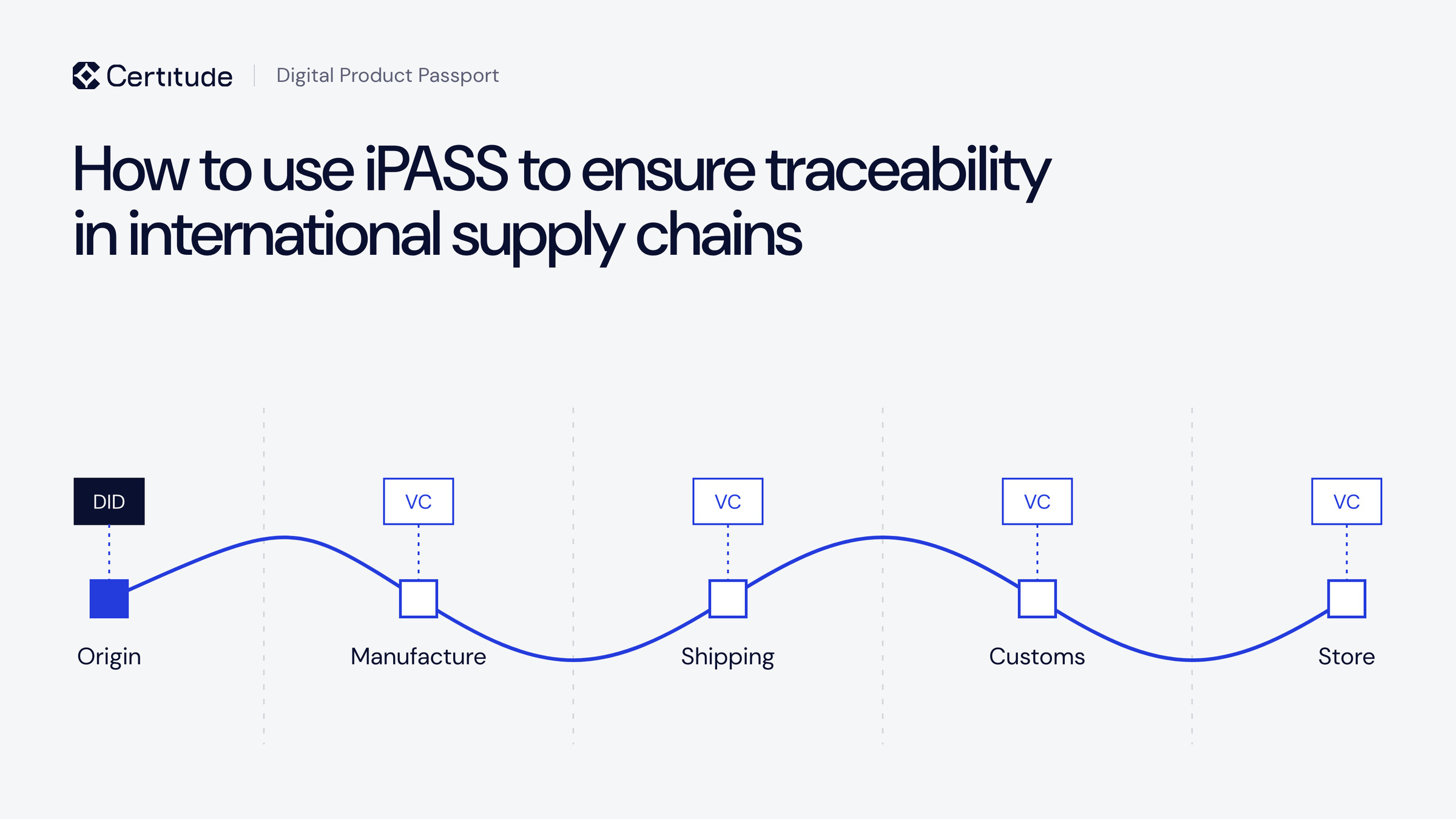
- Each milestone in the life of the battery (extraction, manufacturing, assembly, transport, installation, use, maintenance, recycling) is documented in the form of Verifiable Credentials (VCs).
- These are digitally signed with DID technology and registered in blockchain, guaranteeing their authenticity.
- Access via QR/URL:
- The product incorporates a unique QR code that allows manufacturers, auditors, consumers, and recyclers to access information in real time.
- Compliance with the battery regulation:
- iPASS is designed to cover the specific requirements of the regulations:
- Information on the carbon footprint.
- Composition and origin of raw materials.
- Recycling compliance certificates.
- Durability and guarantees.
Benefits of iPASS for each Actor in the Ecosystem
For battery manufacturers:
- Simplification of regulatory compliance.
- Greater confidence and reputation with customers and authorities.
- Competitive advantage in a market that demands sustainability.
For auditors and regulators:
- Fast and reliable access to information.
- Verifiable evidence without risk of manipulation.
- Facilitation of inspections and reports.
For consumers and end users:
- Total transparency on the origin and impact of batteries.
- Guarantee of safety and durability.
- Confidence that they are acquiring a product aligned with sustainability.
For recyclers and waste managers:
- Precise information on the composition of each battery.
- Improvement in the efficiency of recycling and recovery of critical materials.
Use Case: battery for electric vehicle
Let’s imagine a manufacturer of batteries for electric vehicles that must comply with the regulations.
- With iPASS, it registers each batch of cells indicating the origin of lithium and cobalt.
- Throughout production, safety and carbon footprint certifications are added.
- When the battery arrives at the dealership, the consumer can scan a QR code to check the durability, warranty, and recycling conditions.
- At the end of its useful life, the recycling company accesses the exact composition of the battery, maximizing the recovery of materials.
In this way, a transparent and efficient cycle is created, aligned with European regulations.
Challenges that iPASS solves
- Prevents data falsification thanks to the immutability of blockchain.
- Facilitates integration with management systems already used by manufacturers.
- Reduces compliance costs by centralizing the entire process in a single solution.
- Promotes consumer confidence by showing transparency and sustainability.
The battery sector is facing a decisive stage: the European Union demands more transparency, sustainability, and responsibility throughout the value chain. The Digital Product Passport will be the key instrument to achieve this.
In this context, iPASS not only helps to comply with the regulations, but also offers companies the possibility of transforming an obligation into a competitive advantage, generating consumer confidence and optimizing internal processes.
The future of batteries will not only be measured in charging capacity or durability, but also in sustainability and transparency. And with iPASS, this future is already within reach.